Objectives
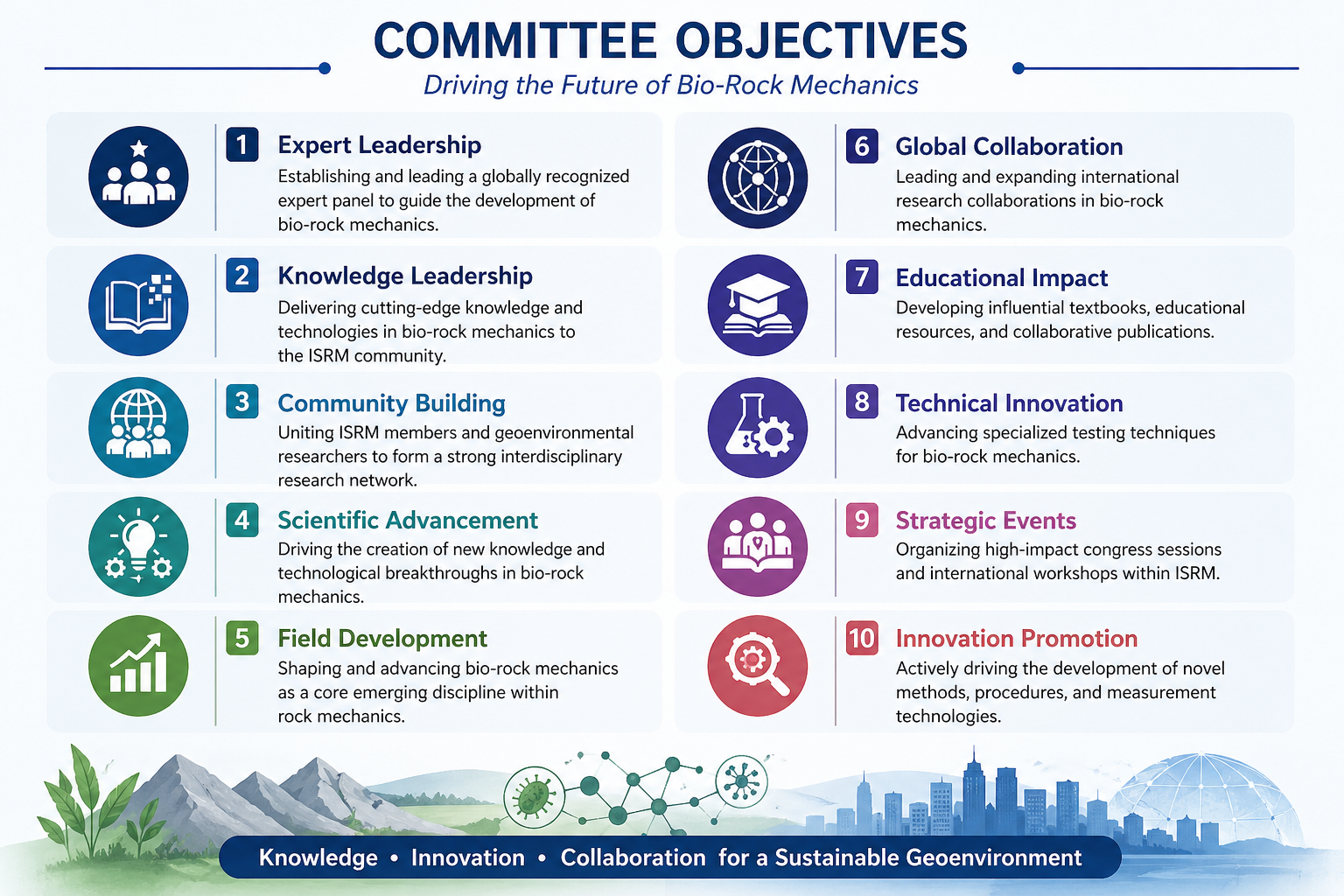
- To establish a recognized expert panel to provide advice on bio-rock mechanics.
- To provide and disseminate the latest knowledge and technology in the field to the members of ISRM.
- To foster closer relationships between ISRM members and geoenvironmental researchers interested and involved in bio-rock mechanics.
- To contribute to the generating of knowledge and technology in the field of bio-rock mechanics.
- To stimulate research interests and advance a new field within rock mechanics.
- To facilitate and enhance international collaborations in bio-rock mechanics research.
- To explore the publication of textbook(s), educational materials, and collaborative publications related to bio-rock mechanics.
- To discuss and develop testing techniques specific to bio-rock mechanics.
- To organize congress sessions and/or workshops on bio-rock mechanics in ISRM events.
- To actively solicit and invite researchers to develop new methods, procedures, or equipment for testing techniques and measurements in bio-rock mechanics studies.
Working Principles and Planed Activities
The Commission will operate under the fundamental principle of adhering to international rules on the fair and equitable sharing of benefits arising from the access and use of genetic resources, particularly those associated with endolithic microorganisms. The Commission will employ a multidisciplinary approach, utilizing field investigations, laboratory experiments, and mathematical and numerical modelling techniques to establish a comprehensive framework for bio-rock mechanics. This framework will be guided by the following vision:Long-term vision
- Elucidation of the relationship between microbial weathering/mineralization and the mechanical behaviour of rocks
Microscopic and macroscopic weathering and mineralization phenomena caused by microbial activity on/in rocks will be discussed through field investigations, laboratory experiments including image-based analysis, and literature review. - Mechanical and environmental assessment of microbial effects on geo-hazards
The relationship between microorganisms in rocks and geo-hazards will be discussed through field investigation, laboratory experiments, and literature review. Past disaster cases will be re-examined in terms of microbial activity in rocks. - Development of mathematical and numerical models for the impact of microorganisms on rocks
Mathematical models will be developed to represent microbial weathering and mineralization phenomena. Additionally, simulation techniques and software codes will be developed to deduce microbial phenomena in rocks using data from field investigations and laboratory experiments.
- Initial Phase – Establishment and endorsement
This phase will involve the establishment and endorsement of the Commission and setting the goals of the Commission through virtual meetings as well as face-to-face meetings of the Commission members. Furthermore, some early outcomes of some of the commission members will be actively presented in the upcoming ISRM events. - 2nd Phase – What is bio-rock and its mechanics?
A "Bio-Rock Workshop" and/or congress sessions will be organized and held at an international conference hosted by ISRM during this phase. The workshop will showcase outcrops where microbial degradation and mineralization have been observed and will discuss methodologies for laboratory and field-based experiments, mathematical modelling, and numerical simulation. Manuscripts presented at the workshops will be selected and compiled into a book to reach a wider audience. Specific publication methods and fees will be determined through negotiations with several publishers. - 3rd Phase– What methods are available to understand bio-rock and its mechanics?
Accumulate data to be compiled in a book as a testing method for field investigations, laboratory experiments, and computational methods necessary for bio-rock mechanics. This accumulation will include the integration of knowledge on current and/or state-of-the-art testing methods in rock mechanics. Testing methods developed in this phase will be evaluated individually and, if approved by the ISRM Commission on Testing Methods and ISRM, forwarded for publication by the ISRM Commission on Testing Methods. Therefore, during this phase, we will cooperate with the ISRM Commission on Testing Methods to actively integrate knowledge. - 4th Phase– What is the way forward for the bio-rock mechanics?
Based on the activities of the previous phases, we will identify issues in bio-rock mechanics. Subsequently, we will discuss the way forward for this field and develop a roadmap.
Past Reports
We organized and managed an international workshop and proposed a roadmap for biogeochemical locking mechanisms. Abstract
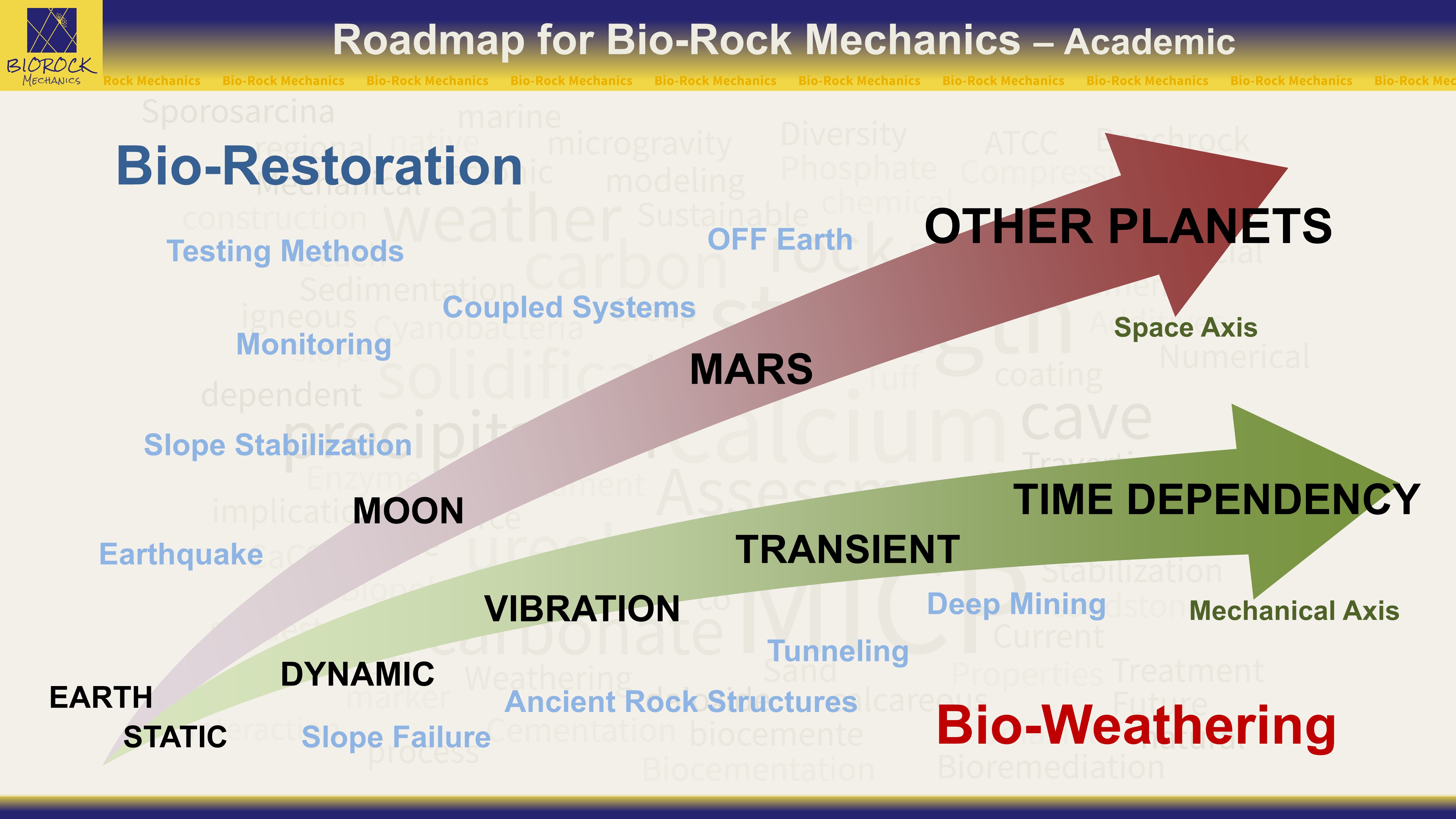
An Academic Research Roadmap for Bio-Rock Mechanics